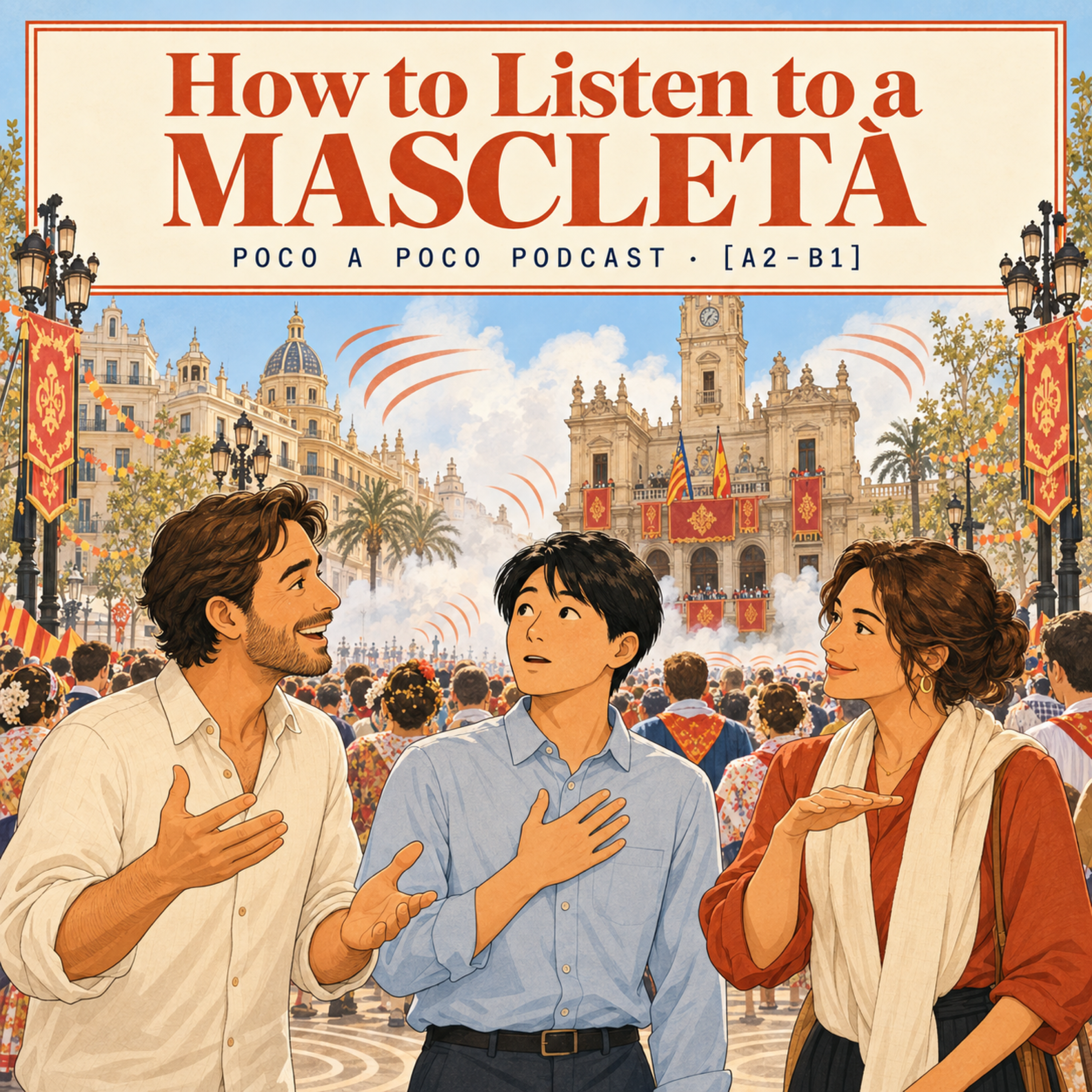
Portada EP. 11 — Las Fallas Explained | How to Listen to a Mascletà
EP. 11 A2–B1

Las Fallas Explained | How to Listen to a Mascletà

Yuki aprende a escuchar el ritmo, la vibración y el silencio final

11 SEP 2026  ·  12 MIN

Spotify Apple Podcasts iVoox Amazon Music

A slow Spanish story with English explanations: enter Valencia’s mascletà and learn to hear its rhythm, progression and physical intensity.

What you'll learn in this episode

Free downloads for this episode

Materiales del episodio

Descarga el PDF o lee directamente aquí

Vocabulario

Palabras y expresiones con matiz cultural — flashcards, mini-juego y quiz interactivos

Transcripción

Texto completo del episodio en español con notas en inglés

Gramática

Explicación en profundidad del punto gramatical del episodio con ejemplos

Traducción completa

Episodio completo en inglés con vocabulario y gramática marcados

Frase a frase

Análisis línea por línea del episodio — solo disponible en PDF

Espacio publicitario · 300×250
↑ Volver arriba

Vocabulario — EP. 11: Las Fallas Explained | How to Listen to a Mascletà

20 palabras y expresiones extraídas directamente del episodio, con su matiz cultural explicado en español e inglés.

EspañolEnglishEjemplo del episodio
Descargar mazo Anki — 20 palabras × 2 tarjetas (ES→EN y EN→ES)

Tarjetas de memoria

Haz clic en la tarjeta para ver la traducción completa, la explicación y el ejemplo del episodio.

Español clic para ver →
English

🇪🇸 ¿Por qué es especial?
🇬🇧 In English

Haz clic para voltear · usa ← → para navegar

1 / 20

Mini-juego — ¿Qué significa?

Respuesta inmediata con feedback detallado cuando fallas.

¿Qué significa en inglés…?

Quiz — Ponte a prueba

Selecciona tu respuesta y lee la explicación antes de continuar.

Pregunta 1 de 20

¿Qué significa en inglés…?

Espacio publicitario · Responsive
↑ Volver arriba

Transcripción - EP. 11: Las Fallas Explained | How to Listen to a Mascletà

Introduction (English)

Imagine this...

It is two minutes to two... in Valencia.

Thousands of people are standing in the same square.

But nobody is looking at a stage.

Everyone is waiting... for a sound.

Today... we are going to enter that square...

and discover the mascletà...

by listening first... and explaining afterwards.

This is Poco a Poco...

a podcast for learners who want real Spanish... without rushing.

Today's scene is a dramatization... inspired by real first visits to a mascletà.

In our story... I am there with Yuki.

I will tell you what he asks... and what surprises him.

And today... Isabel is here with me...

to help me share the whole experience with you.

After the story... we will explore four useful expressions...

and one simple way to connect intensity... with consequence.

You will also find five free study guides... in the episode description.

We are almost ready.

Let us enter the square.

Empezamos.

Cuerpo principal (Español)

Imaginad la escena...

Son casi las dos.

Hace calor... y la plaza está a reventar.

La gente avanza muy despacio... buscando un pequeño espacio.

Yuki me pregunta por qué han llegado todos con tanta antelación.

Yo le doy una respuesta rápida.

Demasiado rápida.

Le digo que vienen a escuchar ruido.

Isabel me mira... y levanta una ceja.

- Juan... no le expliques todavía.

- Primero... que escuche.

- Mira a tu alrededor.

- Nadie mira hacia un escenario.

- La gente habla... pero también está esperando.

- Escucha cómo cambia la plaza... justo antes de las dos.

Isabel tiene razón.

Yuki mira hacia arriba... como si el espectáculo estuviera escondido en el cielo.

- Yuki... todavía no mires arriba.

- Cierra los ojos... y escucha.

Yuki obedece.

Al principio... oye conversaciones.

Oye teléfonos... pasos... y una sirena muy lejos.

Después... nota algo distinto.

Las conversaciones son más cortas.

La gente mira la hora.

Algunas personas levantan una mano... para señalar que falta muy poco.

Hay tanta gente... que casi no podemos movernos.

Yuki me pregunta si siempre llega tanta gente.

Le explico que... durante las Fallas...

la mascletà municipal se celebra en esta plaza... a las dos de la tarde.

Del uno al diecinueve de marzo... hay una cada día.

En los días con más público... algunas personas llegan hasta una hora antes.

- Y esa espera... también forma parte de la experiencia.

- Unas personas buscan un lugar desde el que puedan escuchar bien.

- Otras hablan con amigos... miran el balcón... o recuerdan la mascletà del día anterior.

- La plaza todavía no está en silencio...

- pero toda esa conversación... ya apunta hacia la misma hora.

- Pero cuidado con la palabra siempre.

- Cada día es distinto.

- Y cada persona vive la mascletà... de una manera diferente.

Yuki vuelve a mirar el cielo.

Espera colores... luces... dibujos.

Es normal.

Cuando pensamos en fuegos artificiales... pensamos en la noche.

Pensamos en mirar.

- Una mascletà también es un espectáculo pirotécnico...

- pero aquí... el sonido y el ritmo son fundamentales.

- Es de día.

- No tienes que buscar una historia en el cielo.

- Tienes que notar... cómo cambia el sonido.

- Primero llegan sonidos separados.

- Después se acercan... se agrupan... y ganan intensidad.

- La emoción nace de esa progresión.

- Por eso no basta con decir... que son explosiones.

Yo intento ayudar.

Le digo a Yuki que imagine una escalera.

El primer escalón está abajo.

Después... cada escalón sube un poco más.

Isabel niega con la cabeza.

- No conviertas la mascletà en una clase de matemáticas.

Tiene razón... otra vez.

Y entonces... llega el primer disparo.

El sonido rompe la espera.

Retumba entre los edificios... y parece quedarse un momento en la plaza.

Yuki abre los ojos.

No dice nada.

Solo se queda quieto.

Yo recuerdo esa reacción.

La primera vez... el cuerpo entiende algo antes que la cabeza.

Otro sonido.

Después... otro.

Todavía hay espacio entre ellos.

- No intentes reconocer cada petardo.

- Escucha la distancia entre uno y otro.

- Y cuando llegue una traca... fíjate en cómo cambia la continuidad.

- Escucha ese espacio.

- No es un silencio vacío.

- Te prepara para lo que viene después.

Yuki empieza a prestar atención.

Ya no mira arriba.

Mira a la gente.

Mira cómo algunas personas sonríen... cuando reconocen un cambio.

Me pregunta cómo saben lo que va a pasar.

Yo estoy a punto de responder.

- Déjale descubrirlo.

Así que esperamos.

Los sonidos empiezan a llegar con más frecuencia.

Primero... podemos separarlos.

Después... forman grupos.

Y poco a poco... aparece un ritmo.

No es una canción.

Pero tampoco es un ruido sin forma.

Isabel mueve una mano... como si siguiera el pulso.

- Ahora cambia.

- ¿Lo notas?

Yuki asiente.

El ritmo va tan rápido... que ya no puede contar cada sonido.

La plaza está tan llena... que nadie puede abrirse paso con facilidad.

Y el sonido es tan fuerte... que sentimos la vibración en el pecho.

Ahí aparece otra parte de la experiencia.

No solo escuchas con los oídos.

Notas el suelo.

Notas el aire.

Notas la ropa... moverse un poco con cada golpe.

Y llega también... el olor a pólvora.

Es un olor seco... intenso... difícil de confundir.

Yuki estaba tan sorprendido... que se quedó completamente quieto.

Yo le pregunto si está bien.

Él asiente... sin apartar la atención de la plaza.

- Está escuchando.

- Ahora sí.

El ritmo continúa creciendo.

Cada parte parece empujar a la siguiente.

El sonido llena el espacio.

Durante unos segundos... es ensordecedor.

Pero Yuki ya no intenta escapar de la sensación.

Respira... y sigue el cambio.

Yo también dejo de explicar.

No hay nada útil que añadir en ese momento.

Entonces... todo se concentra.

El final llega como una ola muy rápida.

El suelo vibra.

El sonido retumba entre las fachadas.

Y de golpe...

silencio.

Durante un instante... nadie habla.

Después... la plaza entera aplaude.

Yuki abre mucho los ojos.

Ya no me pregunta por qué la gente quiere escuchar ruido.

Me pregunta... cómo sabía todo el mundo que aquello era el final.

La pregunta me hace sonreír.

Ha dejado de buscar explosiones sueltas.

Ha empezado a escuchar la estructura.

Yo digo que ya entiende la mascletà.

Isabel me corrige... con mucha calma.

- Entiende mejor... esta mascletà.

- Eso no significa que entienda todas.

- Y tampoco significa... que tenga que gustarle.

Esa diferencia es importante.

Reconocer un ritmo... no es lo mismo que disfrutarlo.

Hay valencianos que esperan este momento con emoción.

Hay otros que prefieren mantenerse lejos del ruido.

Y hay personas que cambian de opinión... según el día.

- Una tradición no convierte a todo el mundo... en la misma persona.

- Y una mascletà en esta plaza... no representa toda España.

- Yo puedo disfrutar del ritmo... y aun así preferir un poco de distancia.

- Otra persona puede acercarse más... o decidir no venir.

- Las tres respuestas son personales.

Además... la experiencia no termina aquí.

Muchas comisiones falleras organizan mascletaes en distintos barrios.

Cada lugar cambia el tamaño... la cercanía... y la relación con la gente.

Nosotros hoy... solo hemos entrado en una escena concreta.

Una plaza.

Una espera.

Un ritmo que crece.

Y un silencio final... seguido por aplausos.

Mientras salimos... todavía cuesta abrirse paso.

El olor a pólvora permanece en el aire.

Yuki vuelve a tocarse el pecho.

Me pregunta si la vibración siempre se siente así.

Yo miro a Isabel... antes de responder.

- Muy bien, Juan.

- Esta vez... no vas a generalizar.

Esta vez... digo solamente la verdad sobre nuestro momento.

Era tan fuerte... que nos vibraba el pecho.

Yuki sonríe.

Quizá no sabe todavía... si le ha gustado.

Pero ya sabe... qué estaba escuchando.

Closing - Vocabulary & Grammar (English)

And now... let us unpack what happened in the square.

First... la mascletà.

Fireworks is not a complete translation.

A mascletà is a daytime pyrotechnic display...

built around sound... rhythm... progression... and physical sensation.

Keep the Valencian spelling... with its accented à.

Second... retumbar.

A sound retumba when it resonates powerfully through a space.

El sonido retumba entre los edificios.

It is stronger and more physical than simply sonar... to sound.

Third... estar a reventar.

This informal expression means... to be absolutely packed.

La plaza estaba a reventar.

It describes how full the place is... not necessarily danger.

Fourth... abrirse paso.

It means to make your way through people or obstacles.

Nos costaba abrirnos paso entre la gente.

You can use it in a crowd... a station... or a busy market.

Now... the grammar hidden inside the experience.

Use tan with an adjective or an adverb... and que for the consequence.

El sonido era tan fuerte... que vibraba el suelo.

El ritmo iba tan rápido... que Yuki no podía contar cada sonido.

With a noun... use tanto or tanta.

Había tanta gente... que casi no podíamos avanzar.

Tan describes intensity.

Tanto or tanta describes quantity.

Then que introduces the result.

Era tan fuerte... que me vibraba el pecho.

It was so loud... that I could feel it vibrating in my chest.

Now make one sentence about your own city.

La música era tan fuerte... que...

Había tanta gente... que...

Complete the consequence... and make it yours.

In the episode description... you will find five free study guides.

Transcript... vocabulary... grammar... translation... and phrase by phrase.

Next time... we move from a huge public celebration...

to an ordinary morning... when everything goes wrong.

Thank you for listening... and for learning with us.

Poco a poco... se llega lejos.

Hasta pronto.
↑ Volver arriba

Gramática - EP. 11: Las Fallas Explained | How to Listen to a Mascletà

Tan... que y tanto/tanta... que: intensidad, cantidad y consecuencia

Explicación en español

Estas estructuras conectan una intensidad o una cantidad con su resultado. Usa «tan» delante de un adjetivo o adverbio: «el sonido era tan fuerte que vibraba el suelo» y «el ritmo iba tan rápido que Yuki no podía contar». Usa «tanto», «tanta», «tantos» o «tantas» delante de un sustantivo y hazlo concordar: «había tanta gente que casi no podíamos avanzar». En ambos casos, «que» introduce la consecuencia. No confundas «tan» con «tanto»: «tan fuerte» describe el grado de un adjetivo; «tanta gente» cuantifica un sustantivo.

English explanation

These structures connect intensity or quantity with a result. Use tan before an adjective or adverb: «el sonido era tan fuerte que vibraba el suelo» and «el ritmo iba tan rápido que Yuki no podía contar». Use tanto, tanta, tantos or tantas before a noun and make it agree: «había tanta gente que casi no podíamos avanzar». In both patterns, que introduces the consequence. Do not confuse tan with tanto: «tan fuerte» describes the degree of an adjective, while «tanta gente» quantifies a noun.

Ejemplos / Examples

El sonido era tan fuerte que vibraba el suelo.

The sound was so loud that the ground vibrated.

ES «Tan» modifica el adjetivo «fuerte» y «que» introduce el resultado.

EN Tan modifies the adjective fuerte, and que introduces the result.

El ritmo iba tan rápido que Yuki no podía contar cada sonido.

The rhythm was moving so fast that Yuki could not count each sound.

ES «Tan» también puede modificar un adverbio como «rápido».

EN Tan can also modify an adverb such as rápido.

Había tanta gente que casi no podíamos avanzar.

There were so many people that we could hardly move forward.

ES «Tanta» concuerda en femenino singular con el sustantivo colectivo «gente».

EN Tanta agrees in the feminine singular with the collective noun gente.

Yuki estaba tan sorprendido que se quedó completamente quieto.

Yuki was so surprised that he stayed completely still.

ES La consecuencia puede describir una reacción física o emocional.

EN The consequence can describe a physical or emotional reaction.

Espacio publicitario · 300×250
↑ Volver arriba

Traducción completa - EP. 11: Las Fallas Explained | How to Listen to a Mascletà

Introduction

Imagine this...

It is two minutes to two... in Valencia.

Thousands of people are standing in the same square.

But nobody is looking at a stage.

Everyone is waiting... for a sound.

Today... we are going to enter that square...

and discover the mascletà...

by listening first... and explaining afterwards.

This is Poco a Poco...

a podcast for learners who want real Spanish... without rushing.

Today's scene is a dramatization... inspired by real first visits to a mascletà.

In our story... I am there with Yuki.

I will tell you what he asks... and what surprises him.

And today... Isabel is here with me...

to help me share the whole experience with you.

After the story... we will explore four useful expressions...

and one simple way to connect intensity... with consequence.

You will also find five free study guides... in the episode description.

We are almost ready.

Let us enter the square.

Let's begin.

Main story translated from Spanish

Imagine the scene...

It is almost two o'clock.

It is hot... and the square is absolutely packed.

People move very slowly... looking for a small space.

Yuki asks me why everyone has arrived so early.

I give him a quick answer.

Too quick.

I tell him they have come to listen to noise.

Isabel looks at me... and raises an eyebrow.

Juan... do not explain it to him yet.

First... let him listen.

Look around you.

Nobody is looking towards a stage.

People are talking... but they are also waiting.

Listen to how the square changes... just before two.

Isabel is right.

Yuki looks up... as if the show were hidden in the sky.

Yuki... do not look up yet.

Close your eyes... and listen.

Yuki obeys.

At first... he hears conversations.

He hears phones... footsteps... and a siren far away.

Then... he notices something different.

The conversations are shorter.

People check the time.

Some people raise a hand... to signal that there is very little time left.

There are so many people... that we can hardly move.

Yuki asks me whether this many people always come.

I explain that... during Las Fallas...

the municipal mascletà takes place in this square... at two in the afternoon.

From the first to the nineteenth of March... there is one every day.

On the busiest days... some people arrive up to an hour early.

And that wait... is also part of the experience.

Some people look for a place where they can hear well.

Others talk with friends... look at the balcony... or remember the previous day's mascletà.

The square is not silent yet...

but all that conversation... is already pointing towards the same time.

But be careful with the word always.

Every day is different.

And each person experiences the mascletà... in a different way.

Yuki looks at the sky again.

He expects colours... lights... patterns.

It is normal.

When we think of fireworks... we think of the night.

We think about looking.

A mascletà is also a pyrotechnic display...

but here... sound and rhythm are fundamental.

It is daytime.

You do not have to look for a story in the sky.

You have to notice... how the sound changes.

First, separate sounds arrive.

Then they get closer... group together... and build in intensity.

The emotion comes from that progression.

That is why it is not enough to say... that they are explosions.

I try to help.

I tell Yuki to imagine a staircase.

The first step is at the bottom.

Then... each step goes a little higher.

Isabel shakes her head.

Do not turn the mascletà into a maths lesson.

She is right... again.

And then... the first discharge arrives.

The sound breaks the wait.

It reverberates between the buildings... and seems to remain in the square for a moment.

Yuki opens his eyes.

He says nothing.

He just stays still.

I remember that reaction.

The first time... the body understands something before the mind does.

Another sound.

Then... another.

There is still space between them.

Do not try to identify every firecracker.

Listen to the distance between one and the next.

And when a string of firecrackers starts... notice how the continuity changes.

Listen to that space.

It is not an empty silence.

It prepares you for what comes next.

Yuki begins to pay attention.

He is no longer looking up.

He looks at the people.

He watches how some people smile... when they recognise a change.

He asks me how they know what is going to happen.

I am about to answer.

Let him discover it.

So we wait.

The sounds begin to arrive more frequently.

At first... we can separate them.

Then... they form groups.

And little by little... a rhythm appears.

It is not a song.

But it is not shapeless noise either.

Isabel moves one hand... as if she were following the beat.

Now it changes.

Can you feel it?

Yuki nods.

The rhythm is moving so fast... that he can no longer count each sound.

The square is so full... that nobody can make their way through easily.

And the sound is so loud... that we feel the vibration in our chests.

That is where another part of the experience appears.

You do not listen only with your ears.

You feel the ground.

You feel the air.

You feel your clothes... move a little with every impact.

And the smell of gunpowder arrives too.

It is a dry smell... intense... hard to mistake.

Yuki was so surprised... that he stayed completely still.

I ask him if he is all right.

He nods... without taking his attention away from the square.

He is listening.

Now he is.

The rhythm continues to build.

Each part seems to push the next one forward.

The sound fills the space.

For a few seconds... it is deafening.

But Yuki is no longer trying to escape the sensation.

He breathes... and follows the change.

I stop explaining too.

There is nothing useful to add at that moment.

Then... everything becomes concentrated.

The ending arrives like a very fast wave.

The ground vibrates.

The sound reverberates between the façades.

And suddenly...

silence.

For an instant... nobody speaks.

Then... the whole square applauds.

Yuki opens his eyes wide.

He no longer asks me why people want to listen to noise.

He asks me... how everyone knew that was the ending.

The question makes me smile.

He has stopped looking for separate explosions.

He has started listening to the structure.

I say that he now understands the mascletà.

Isabel corrects me... very calmly.

He understands this mascletà better.

That does not mean he understands all of them.

And it does not mean... that he has to like it.

That difference is important.

Recognising a rhythm... is not the same as enjoying it.

Some Valencians wait for this moment with excitement.

Others prefer to keep away from the noise.

And some people change their minds... depending on the day.

A tradition does not turn everyone... into the same person.

And a mascletà in this square... does not represent the whole of Spain.

I can enjoy the rhythm... and still prefer a little distance.

Someone else may move closer... or decide not to come.

All three responses are personal.

Besides... the experience does not end here.

Many local Fallas associations organise mascletaes in different neighbourhoods.

Each place changes the scale... the closeness... and the relationship with the people.

Today... we have only entered one specific scene.

One square.

One wait.

A rhythm that grows.

And a final silence... followed by applause.

As we leave... it is still difficult to make our way through.

The smell of gunpowder remains in the air.

Yuki touches his chest again.

He asks me whether the vibration always feels like that.

I look at Isabel... before answering.

Very good, Juan.

This time... you are not going to generalise.

This time... I tell only the truth about our moment.

It was so loud... that our chests were vibrating.

Yuki smiles.

Perhaps he does not yet know... whether he liked it.

But now he knows... what he was listening to.

Closing

And now... let us unpack what happened in the square.

First... the mascletà.

Fireworks is not a complete translation.

A mascletà is a daytime pyrotechnic display...

built around sound... rhythm... progression... and physical sensation.

Keep the Valencian spelling... with its accented à.

Second... retumbar.

A sound retumba when it resonates powerfully through a space.

The sound reverberates between the buildings.

It is stronger and more physical than simply sonar... to sound.

Third... estar a reventar.

This informal expression means... to be absolutely packed.

The square was absolutely packed.

It describes how full the place is... not necessarily danger.

Fourth... abrirse paso.

It means to make your way through people or obstacles.

It was hard for us to make our way through the crowd.

You can use it in a crowd... a station... or a busy market.

Now... the grammar hidden inside the experience.

Use tan with an adjective or an adverb... and que for the consequence.

The sound was so loud... that the ground vibrated.

The rhythm was moving so fast... that Yuki could not count each sound.

With a noun... use tanto or tanta.

There were so many people... that we could hardly move forward.

Tan describes intensity.

Tanto or tanta describes quantity.

Then que introduces the result.

It was so loud... that my chest was vibrating.

It was so loud... that I could feel it vibrating in my chest.

Now make one sentence about your own city.

The music was so loud... that...

There were so many people... that...

Complete the consequence... and make it yours.

In the episode description... you will find five free study guides.

Transcript... vocabulary... grammar... translation... and phrase by phrase.

Next time... we move from a huge public celebration...

to an ordinary morning... when everything goes wrong.

Thank you for listening... and for learning with us.

Little by little... you go a long way.

See you soon.